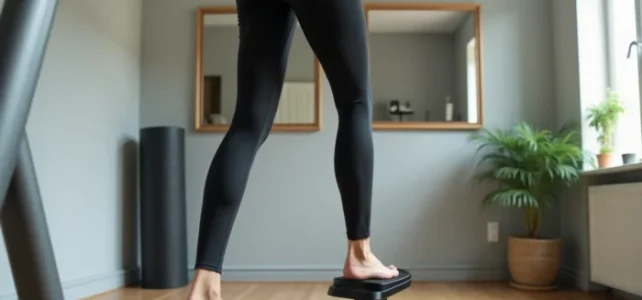
A foot slipping towards the edge of the pedal, a tingling sensation setting in after a few minutes, knee discomfort for no apparent reason: these signals almost always stem from poor foot placement on the elliptical bike. Correcting this placement changes both comfort, the muscles engaged, and the duration for which one can maintain effort without pain.
Midfoot Pressure: The Adjustment That Changes the Elliptical Session
On a treadmill, the heel strikes the ground first. This pattern is often unconsciously replicated on the elliptical, and that’s where the problems begin. A heel-dominant stance shifts the load to the back of the pedal and causes a rocking motion that strains the Achilles tendon.
Conversely, staying on the toes excessively engages the calves and compresses the toes against the front of the shoe. Research from Maastricht University (van den Heuvel et al., 2022) shows that deliberate midfoot pressure improves plantar pressure distribution and reduces the onset of tingling in beginners after about twenty minutes of moderate effort.
Specifically, you want to feel the pedal under the widest part of your foot, between the base of the big toe and the middle of the arch. To check, simply use the foot position on an elliptical bike as a reference and ensure that the heel remains lightly in contact with the pedal without bearing most of the weight.
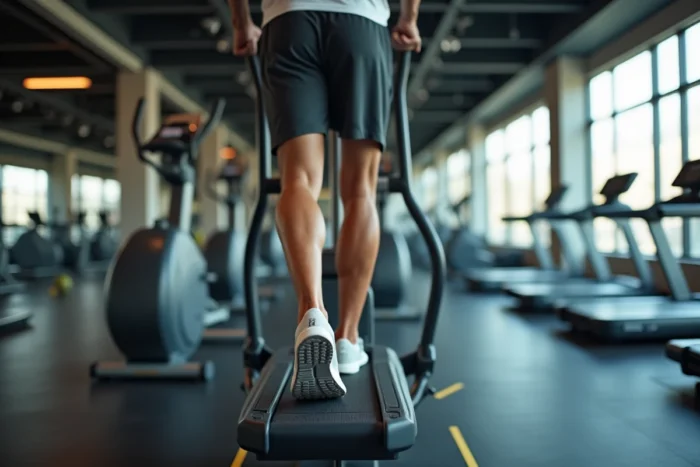
Foot Orientation on the Elliptical: Neutral or Slightly Duck-footed
The question of toe angle often arises, and feedback varies from one user to another. Two positions work well, depending on body type.
Parallel Feet: The Standard for Most Users
Keeping the feet parallel to the edges of the pedal suits the majority of profiles. This orientation keeps the knee aligned with the hip and ankle, limiting lateral stress on the joint.
You can check alignment by looking down during a few strides: if the kneecap points straight ahead and does not deviate inward or outward, the orientation is correct.
Slight External Rotation: Useful for Flat Feet
A study by Kim et al. (2023, Journal of Sports Science and Medicine) indicates that turning the toes 5 to 10 degrees outward reduces strain on the medial knee in individuals with flat feet, without loss of power. This is a subtle but measurable adjustment.
We’re talking about a slight rotation, not an exaggerated angle. Beyond that, the risk of ankle twisting increases. To test, position the feet in a slight duck-footed stance for a few minutes and compare the internal knee sensation to the neutral position.
Foot Position on the Pedal and Muscle Targeting
Shifting the foot a few centimeters forward or backward on the pedal not only changes comfort. It significantly alters muscle recruitment, as shown by an EMG study by Thompson et al. (2021).
- Foot Forward on the Pedal: The work focuses on the quadriceps. You feel more effort in the front of the thigh, which is suitable for leg-strengthening sessions.
- Foot Back on the Pedal: Activation of the hamstrings and glutes increases. This is the position to favor for targeting the posterior chain, often underutilized in the gym.
- Centered Foot (Midfoot): The distribution is balanced between quadriceps, glutes, and calves. This is the basic placement for cardio sessions at moderate resistance.
You can alternate these placements during the same session. For example, start with a centered foot during warm-up, move the foot back for a high-resistance phase, then return to center for cool-down.
Placement Errors That Cause Knee Pain on the Elliptical
Two patterns frequently recur and explain the majority of joint pain related to the elliptical.
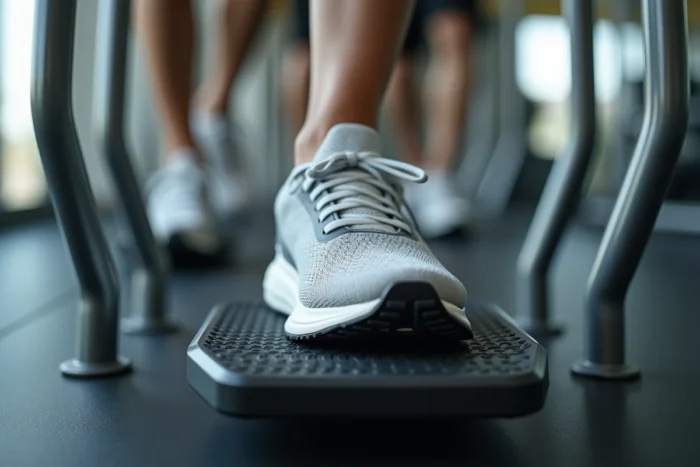
The first: a foot drifting towards the outer edge of the pedal. The knee then goes into valgus (inward), overloading the medial collateral ligament. This flaw often occurs when the pedals are too wide relative to the width of the pelvis, or when using very soft-soled shoes that do not support the foot.
The second: lifting the heel with each stride, as if climbing stairs. This movement turns the elliptical into a stepper simulator and concentrates the load on the front of the foot. The metatarsals endure repetitive stress that leads to numbness, then pain under the forefoot after a few sessions.
To correct these two flaws, keep a simple guideline: the heel never completely leaves the pedal. It may lift a few millimeters at the end of the push, but it should not fully detach. This single correction often realigns the knee and eliminates overload on the metatarsals.
Shoes and Elliptical Machine Settings: The Details That Matter
The foot placement also depends on what you wear and the machine itself. A running shoe with a high drop (elevated heel) naturally shifts weight towards the front of the foot. On the elliptical, a shoe with a low or moderate drop provides better flat contact with the pedal.
On the machine side, stride length plays a direct role. A stride that is too long for the user’s height forces the leg to stretch at the end of the stroke, which lifts the heel. If you notice that the heel consistently lifts, reducing the stride length by one notch often resolves the issue.
Resistance also has its effect: at very low resistance, you lose control of the movement and the feet slide on the pedals. A sufficient resistance to feel a firm pressure stabilizes the foot and allows you to maintain the chosen placement throughout the exercise.
Adjusting foot placement takes less than a minute and costs nothing. Before the next session, check three points: weight on the midfoot, toes aligned or slightly open, and the heel remaining in contact. These simple corrections protect the joints and allow you to get the most out of every minute spent on the elliptical.