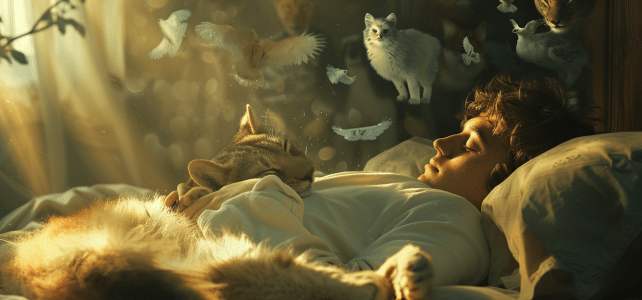
Animal dreams have always fascinated us. When a lion, a snake, or a bird appears in our sleep, these images provoke thoughts and raise questions. Animals in dreams often symbolize aspects of our personality or situations in our daily lives, and their analysis can reveal hidden messages from our unconscious.
For example, a snake may represent transformation or an imminent change, while a bird can symbolize freedom or a spiritual aspiration. Understanding these animal symbols allows for a better understanding of oneself and sheds light on aspects of our lives that we may not always perceive consciously.
Animals in Dreams: Symbols and Meanings
The interpretation of animal dreams is based on a rich tradition of symbolism. Animals are not just simple nocturnal apparitions; they embody archetypes and deep emotions. Tristan-Frédéric Moir, for instance, interprets the horse as a symbol of bodily fullness and acceptance of one’s physical senses. The cat, on the other hand, represents sexuality and desire, while the snake evokes sexual energy.
Sigmund Freud also associated the snake with repressed sexual urges, while Carl Gustav Jung saw the dog as a symbol of instinct, loyalty, and protection. These interpretations show how animals in dreams can carry complex messages.
- Hawk: advises paying attention to the details of daily life.
- Eagle: symbolizes protection and higher energies.
- Ladybug: brings good luck and a positive message.
- Owl: embodies wisdom.
- Wolf: invites solitude or harmonious group living.
- Butterfly: heralds transformation.
- Dove: brings a message of peace.
Another striking example is the dream of a bear. This powerful animal can symbolize inner strength and the ability to overcome obstacles. It can also represent a protective figure or a need for solitude and reflection.
Animals in dreams are not just symbolic figures. They can be guides, protectors, or warners. Their presence in our nights is an invitation to explore our psyche more deeply and to understand the internal dynamics that drive us.
Psychological Interpretations and Practical Applications
The study of animal dreams has gained legitimacy thanks to contributions from various researchers. David M. Peña-Guzmán, in his book ‘When Animals Dream’, explores the psychological and philosophical dimensions of dreams in animals. He shows that animal dreams are revealing of the psychic and emotional life of non-human species.
Abel Brion and Henri Ey, authors of ‘Animal Psychiatry’, have also contributed to this reflection. Their work examines psychic manifestations in animals, offering a clinical perspective on dreams. These studies show that animals, just like humans, go through complex sleep cycles, including phases of dreaming.
Yves Ruckebusch and the Jouvet brothers, with their works ‘Sleep and Dreams in Animals’, have deepened our understanding of animal sleep patterns. They demonstrate that animals go through phases of paradoxical sleep, similar to those of humans, during which they dream.
| Name | Work |
|---|---|
| David M. Peña-Guzmán | ‘When Animals Dream’ |
| Abel Brion & Henri Ey | ‘Animal Psychiatry’ |
| Yves Ruckebusch | ‘Sleep and Dreams in Animals’ |
| M. Jouvet & J. Jouvet | ‘Sleep and Dreams in Animals’ |
Florence Burgat, in ‘The Unconscious of Animals’, examines how dreams reveal unconscious states in animals. She emphasizes the need to consider animals as sensitive beings with a rich psychic life.
These research findings show that animal dreams are not merely a biological phenomenon, but carry deep meanings. They can provide valuable insights into the emotional well-being of animals and how they perceive their environment and their interactions with humans.