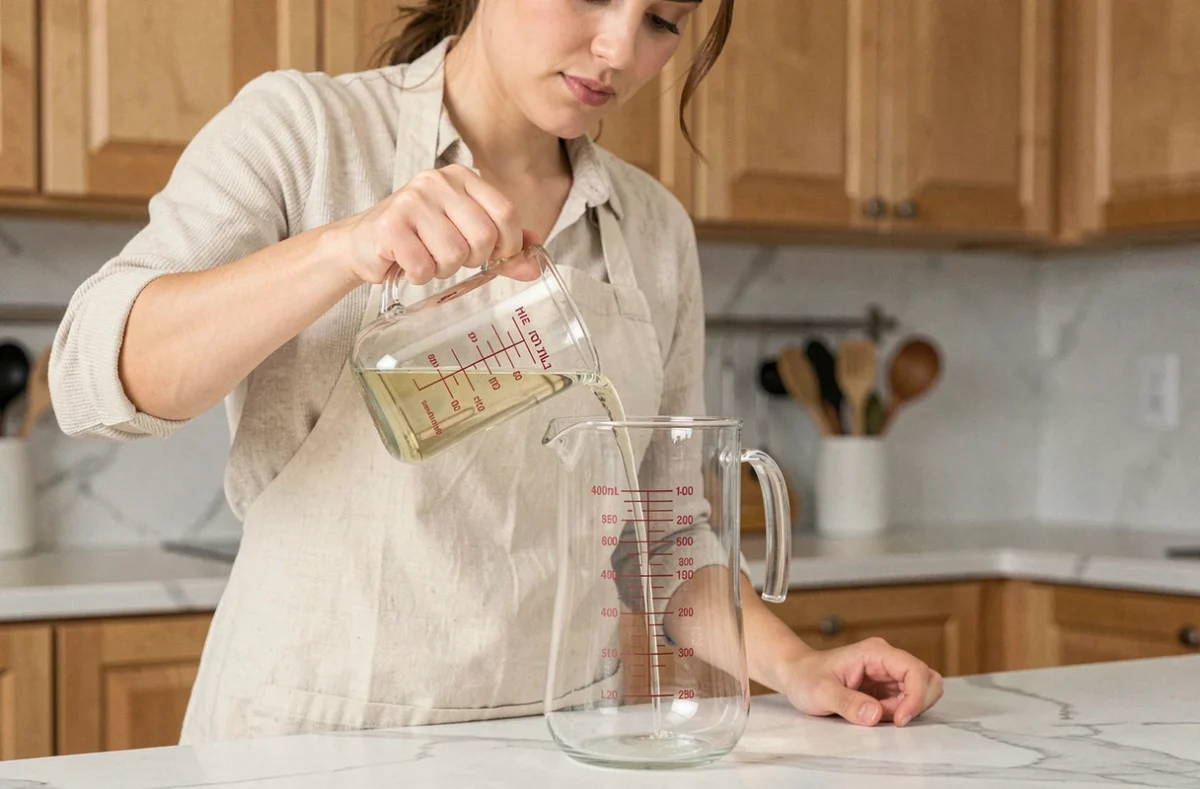
Converting 400 ml to liters involves a single operation: dividing by 1,000. The result is 0.4 L, or more precisely 0.400 L if we keep three significant figures. This distinction is not trivial: it reflects a different level of precision depending on whether you are measuring syrup in cooking or writing an industrial technical sheet.
The International Bureau of Weights and Measures (BIPM) reminds us in the SI Brochure, 9th edition (2019), that a liter is exactly 1 dm³, or 1,000 cm³, and that its symbol does not take a point or plural form.
Conversion Table: Milliliters, Centiliters, and Liters
Before analyzing the pitfalls of conversion, a table helps to position 400 ml in relation to the most common volumes in cooking and laboratories.
| Volume (ml) | Volume (cl) | Volume (L) | Common Example |
|---|---|---|---|
| 50 | 5 | 0.05 | Small liqueur glass |
| 100 | 10 | 0.1 | Standard glass of milk |
| 250 | 25 | 0.25 | Mug, measuring cup |
| 400 | 40 | 0.4 | Carton of cream, broth |
| 500 | 50 | 0.5 | Half a bottle of water |
| 750 | 75 | 0.75 | Bottle of wine |
| 1,000 | 100 | 1 | Carton of milk, bottle of water |
The central column (centiliters) is often the one missing in quick conversions. 400 ml corresponds to 40 cl, a useful reference when a French recipe indicates centiliters rather than milliliters.
To convert 400 ml to liters without error, simply move the decimal point three places to the left. The logic remains the same for any volume expressed in milliliters.
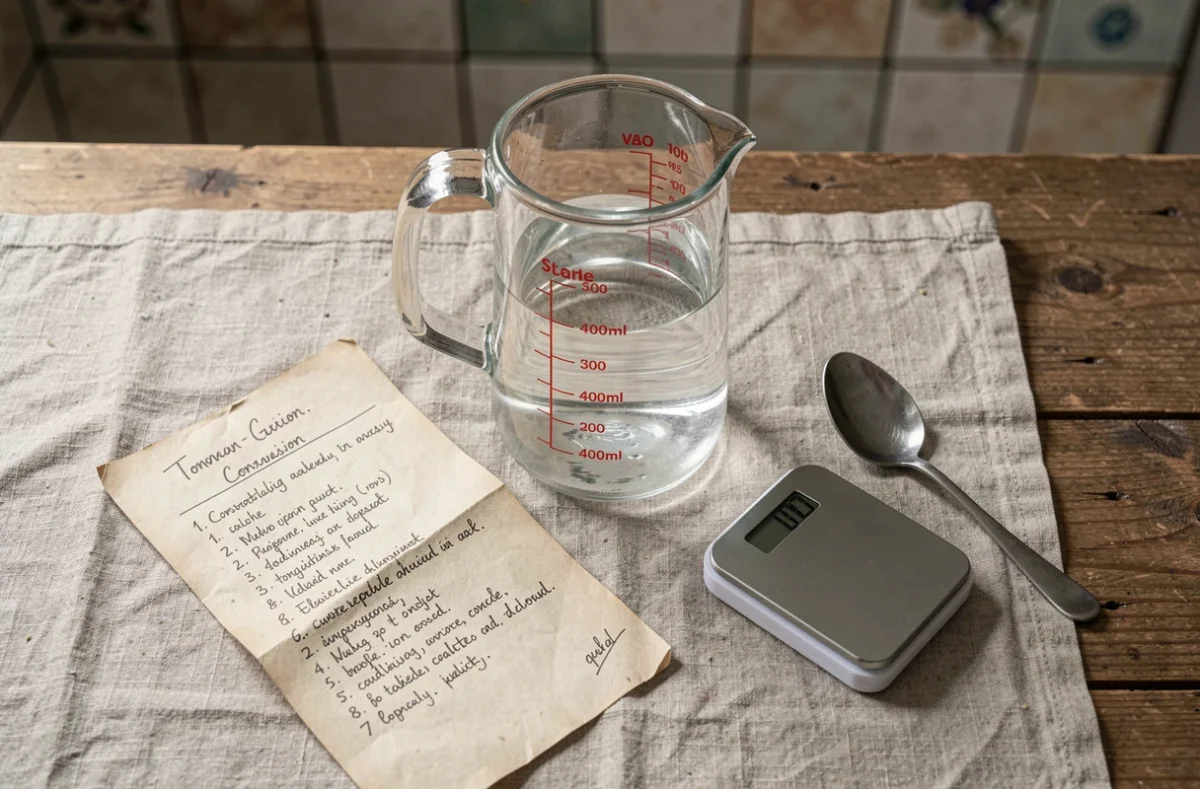
Volume and Mass: Why 400 ml Does Not Always Equal 400 g
This is the most common source of confusion. Volume conversion should not be confused with mass conversion. 400 ml of water weighs about 400 g because the density of water is close to 1 g/ml at room temperature. As soon as you change liquids, the equivalence falls apart.
Oil, for example, is less dense than water. Therefore, 400 ml of oil weighs significantly less than 400 g. Conversely, honey or maple syrup, which are denser, far exceed 400 g for the same volume of 400 ml.
Consequences in Cooking and Baking
Professional baking recipes almost always express ingredients in grams, including liquids. When an amateur recipe states “400 ml of milk,” the actual mass is slightly above 400 g due to the density of whole milk. The difference remains small for milk, but it becomes significant with heavy cream or melted butter.
- Water: 400 ml ≈ 400 g (density close to 1 g/ml)
- Whole milk: 400 ml gives a mass slightly above 400 g
- Vegetable oil: 400 ml weighs significantly less than 400 g
- Honey: 400 ml weighs considerably more than 400 g, as its density is much higher than that of water
Keeping this principle in mind avoids approximate measurements, especially in baking where a few grams of difference can alter the texture of a dough.
Symbols and Notation: Correctly Writing Milliliters and Liters
The BIPM specifies that the recommended symbol is “L” or “l” for liters, and “mL” or “ml” for milliliters. The symbol does not take an abbreviation point or a plural mark. Therefore, we write “400 ml” and not “400 mls” or “400 ml.”
This rule applies to food labels, technical sheets, and regulatory documents. In the European Union, packaging of pre-packaged products displays the nominal quantity according to harmonized standards, which implies standardized typography of units.
Uppercase or Lowercase for Liters
Both forms (“L” and “l”) are accepted. The uppercase “L” was introduced to avoid confusion between the lowercase “l” and the digit “1” in certain fonts. In practice, scientific publications and European labels use both interchangeably.
The notation 0.400 L retains three significant figures, while 0.4 L retains only one. In a laboratory or quality control context, the first form is preferable.

Conversion Method Without a Calculator for Common Volumes
Dividing by 1,000 is simple on paper, but in real situations (kitchen, workshop, garden), you don’t always have a screen at hand. Two mental benchmarks speed up the calculation.
The first is to think in centiliters as an intermediate step. Dividing milliliters by 10 gives centiliters, then dividing by 100 gives liters. For 400 ml: 400 ÷ 10 = 40 cl, then 40 ÷ 100 = 0.4 L.
The second benchmark is fractional. 400 ml represents exactly 2/5 of a liter, which is just under half a liter. This fraction is easy to visualize: mentally fill a one-liter bottle to two-fifths.
- 250 ml = 1/4 of a liter
- 333 ml ≈ 1/3 of a liter
- 400 ml = 2/5 of a liter
- 500 ml = 1/2 liter
These fractions are more intuitive than a decimal number when measuring by eye in a graduated container.
The conversion of 400 ml to liters boils down to a division by 1,000, but its reliability depends on two precautions: not confusing volume and mass, and adhering to the standardized notation of the symbol. For everyday measurements, remembering that 400 ml equals 40 cl, 0.4 L, or 2/5 of a liter covers almost all situations.